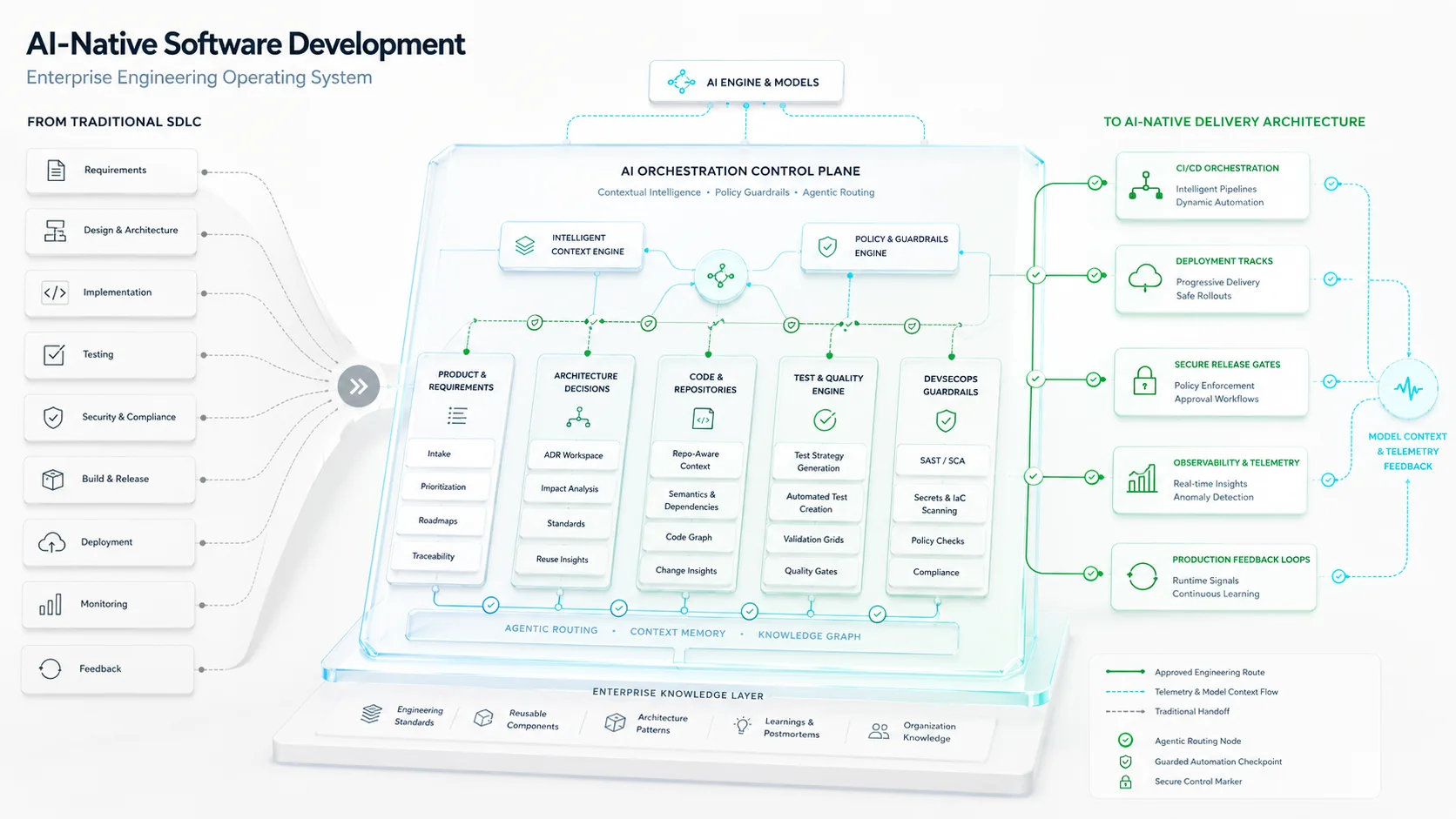
AI-Native Software Development: The Next Enterprise Technology Shift
AI-native software development is not simply AI-assisted coding. It is a new enterprise engineering model where intelligent systems support architecture decisions, requirements analysis, code generation, testing, security review, deployment, observability, documentation, and continuous product improvement.
The Enterprise Shift Toward AI-Native Software Development
AI-native software development represents a structural change in how enterprises build technology. For years, software delivery has been optimized through agile methods, DevOps practices, cloud-native architecture, CI/CD automation, and platform engineering. These improvements helped teams ship faster, but they did not fundamentally change the relationship between human expertise, engineering workflows, and software production. AI now introduces a new operating layer across the software development lifecycle.
The first wave of adoption focused on AI-assisted coding: generating functions, completing snippets, writing unit tests, and explaining code. Useful, but limited. The next wave is enterprise-grade AI-native software development, where AI becomes part of the engineering system itself. Requirements can be translated into implementation plans. Legacy systems can be analyzed faster. Test cases can be generated from acceptance criteria. Security checks can be embedded earlier. Documentation can remain closer to the code. Delivery workflows can become more intelligent, adaptive, and measurable.
Key Insight
The most important enterprise question is no longer whether developers should use AI. The real question is how the organization designs a governed, secure, measurable, and architecture-aligned AI-native engineering operating model.
What AI-Native Software Development Means
AI-native software development is an engineering approach where artificial intelligence is embedded across planning, architecture, coding, testing, security, deployment, operations, and product feedback loops. It differs from basic AI-assisted coding because it treats AI as a system-level capability rather than a single developer productivity tool.
In an AI-native environment, the software development lifecycle becomes more connected. Product requirements, architecture standards, code repositories, design systems, test suites, cloud environments, observability tools, security policies, and documentation can all inform intelligent workflows. AI does not replace engineering discipline; it increases the need for clear architecture, strong governance, and mature delivery practices.
AI-Assisted Planning
AI helps analyze requirements, identify dependencies, create implementation paths, and surface risk before engineering begins.
Intelligent Engineering
AI supports coding, refactoring, code explanation, test generation, dependency review, and implementation consistency.
Automated Validation
AI improves quality assurance through test coverage analysis, edge-case discovery, vulnerability review, and release readiness checks.
Operational Intelligence
AI connects telemetry, incidents, logs, metrics, and traces to faster diagnosis, remediation suggestions, and learning loops.
Why AI-Native Software Development Matters Now
Enterprise software systems are becoming more complex. Organizations are managing cloud-native platforms, microservices, APIs, legacy modernization, data products, AI applications, compliance obligations, cybersecurity threats, customer experience expectations, and global delivery teams. Traditional engineering processes often struggle under this pressure because too much knowledge remains fragmented across teams, repositories, tickets, documents, and operational systems.
AI-native software development gives enterprises a way to reduce knowledge friction. Instead of manually searching through documentation, engineers can query system context. Instead of relying on tribal knowledge, teams can encode architecture standards into AI-assisted workflows. Instead of discovering security and performance issues late, intelligent validation can shift risk detection earlier in the lifecycle.
Enterprise Signal
AI-native software development becomes valuable when it reduces the distance between business intent, technical design, engineering execution, security validation, deployment, and operational learning.
From Developer Productivity to Engineering System Productivity
Many organizations begin by measuring how much faster individual developers can write code. That metric matters, but it is incomplete. Enterprise value comes from improving the productivity of the entire engineering system. This includes better requirements, cleaner architecture, fewer defects, stronger security, lower rework, faster onboarding, improved maintainability, and more reliable releases.
From Manual Delivery Pipelines to Intelligent SDLC
Traditional software delivery pipelines automate steps. AI-native pipelines interpret context. They can evaluate whether test coverage is appropriate for the change, whether a deployment touches a high-risk service, whether documentation needs updating, whether a security policy applies, and whether operational telemetry suggests a release should be slowed, reviewed, or rolled back.
Core Capabilities of an AI-Native Engineering Model
AI-native software development requires more than a coding assistant. Enterprises need a connected capability model that spans architecture, development, testing, security, operations, knowledge management, and governance. The strongest implementations focus on repeatable workflows where AI can improve speed and quality without introducing unmanaged risk.
1. Requirements Intelligence
AI can summarize stakeholder needs, identify ambiguity, map acceptance criteria, detect missing edge cases, and convert business intent into engineering-ready work.
2. Architecture Assistance
AI can help compare design options, expose dependency risks, review service boundaries, and align implementation decisions with enterprise architecture standards.
3. AI-Assisted Coding
AI can generate code, explain unfamiliar modules, support refactoring, suggest patterns, and help developers navigate complex codebases faster.
4. Intelligent Testing
AI can generate unit tests, integration tests, regression scenarios, synthetic test data, and risk-based validation plans from code and requirements.
5. AI-Powered DevSecOps
AI can support code security review, dependency analysis, policy enforcement, configuration validation, and security-aware release decisions.
6. Operational Learning
AI can analyze incidents, correlate telemetry, recommend remediation, summarize postmortems, and feed lessons back into architecture and delivery practices.
Enterprise Architecture for AI-Native Software Development
AI-native software development should be designed as an enterprise architecture capability. If each team independently adopts tools without shared standards, the organization may gain short-term speed but lose control over security, quality, cost, intellectual property, and maintainability. A strong architecture connects AI systems with approved data sources, engineering platforms, governance policies, and delivery workflows.
Reference Architecture Layers
The Role of Platform Engineering
Internal developer platforms are becoming the natural home for enterprise AI development workflows. Instead of leaving each team to assemble its own tools, platform engineering teams can provide approved AI capabilities through golden paths. These golden paths may include secure coding assistants, repository-aware documentation tools, AI-supported test generation, policy-aware pipeline checks, and deployment guidance based on service risk.
The Role of LLMOps
LLMOps is essential when language models become part of engineering operations. Enterprises need prompt versioning, model evaluation, retrieval quality checks, usage monitoring, cost controls, permission management, safety filters, and feedback loops. Without LLMOps, AI-native software development becomes difficult to measure and risky to scale.
Key Takeaways
- ✓ AI-native software development is a full engineering operating model, not just a coding assistant.
- ✓ The strongest enterprise value comes from connecting AI with architecture, DevOps, security, testing, documentation, and operations.
- ✓ Platform engineering and LLMOps are critical for scaling AI engineering workflows safely and consistently.
- ✓ Governance matters because AI can introduce insecure code, dependency risk, data exposure, inconsistent architecture, and unreviewed automation.
- ✓ Enterprises should measure system-level outcomes such as cycle time, defect reduction, rework, release quality, developer onboarding, and operational resilience.
How AI Changes the Software Development Lifecycle
The software development lifecycle has historically been divided into stages: discovery, planning, design, development, testing, deployment, and maintenance. AI-native software development does not remove those stages. It makes them more connected, context-aware, and continuously improving.
Discovery and Requirements
AI can analyze product briefs, user stories, support tickets, customer feedback, sales notes, and analytics signals to help teams clarify requirements. It can identify contradictions, missing acceptance criteria, unclear dependencies, and areas that need stakeholder alignment. This improves the quality of work before engineering time is committed.
Architecture and System Design
AI can support architecture reviews by comparing design options, checking for consistency with existing standards, identifying coupling risks, and summarizing tradeoffs. However, final architecture decisions still require experienced human judgment. AI can accelerate analysis, but it cannot own accountability for scalability, resilience, security, and long-term maintainability.
Development and Refactoring
AI-assisted coding helps developers produce boilerplate, explore unfamiliar APIs, write helper functions, and refactor repetitive patterns. In enterprise environments, the best results occur when AI is grounded in repository context, code standards, service conventions, and approved libraries.
Testing and Quality Assurance
AI can generate tests from requirements and code changes, identify missing scenarios, propose regression coverage, and help teams understand failure patterns. This is especially valuable in large systems where manual test design struggles to keep pace with change.
Operational Advantage
AI-native SDLC design should focus on reducing late-stage surprises. Better requirements, stronger architecture checks, earlier testing, and continuous security validation produce more reliable delivery than code generation alone.
AI-Assisted Coding Is Only the Starting Point
AI-assisted coding is often the most visible part of AI-native software development because developers interact with it directly. But code generation alone does not solve enterprise delivery problems. A team can generate code faster and still create more technical debt if architecture standards, test quality, security review, and operational readiness are weak.
Basic AI-Assisted Coding
- Autocomplete and snippets
- Function generation
- Code explanation
- Simple test suggestions
AI-Native Engineering
- Context-aware SDLC workflows
- Architecture and security alignment
- Intelligent testing and release checks
- Operational learning loops
The distinction matters. Basic AI-assisted coding optimizes individual output. AI-native engineering optimizes the system that turns business intent into reliable software. Enterprises should pursue the second model if they want durable strategic advantage.
Security, Privacy, and Governance Risks
AI-native software development introduces new risks. AI tools may access proprietary source code, internal documentation, architecture diagrams, customer data, credentials, configuration files, vulnerability reports, or product strategy. Without governance, organizations may expose sensitive information, generate insecure code, violate licensing obligations, or automate decisions that should require human approval.
Source Code Protection
AI tooling should respect repository permissions, data boundaries, IP protection rules, and approved model usage policies.
Secure Code Review
AI-generated code should be reviewed for vulnerabilities, unsafe patterns, dependency risks, insecure defaults, and poor error handling.
Auditability
Teams should track which AI systems influenced code, test plans, design decisions, release gates, or remediation recommendations.
Human Approval for High-Risk Actions
AI can recommend, summarize, generate, and validate. It should not autonomously perform high-risk actions without policy-aware approval. Production deployments, security exceptions, database migrations, access changes, infrastructure modifications, and compliance-sensitive changes require clear control boundaries.
Governance Guardrail
AI-native development should increase engineering control, not weaken it. Every automated workflow needs defined permissions, review paths, audit logs, exception handling, and rollback strategy.
Common Mistakes
AI-native software development fails when enterprises focus on tools before operating model. Buying AI capabilities is easy. Building trusted, scalable, secure, and measurable engineering workflows is harder.
- Treating AI as only a coding tool. This misses larger opportunities in requirements, testing, architecture, security, DevOps, and operations.
- Allowing unmanaged tool adoption. Shadow AI usage can expose source code, customer data, product strategy, and internal documentation.
- Skipping architecture governance. AI can produce working code that still violates service boundaries, performance requirements, or long-term maintainability standards.
- Over-trusting AI-generated tests. Test generation must be evaluated for quality, coverage, edge cases, and alignment with real business scenarios.
- Ignoring developer experience. AI workflows should reduce friction, not create confusing review loops, noisy suggestions, or tool overload.
- Failing to measure system impact. Lines of code generated is not a strategic metric. Enterprises should track delivery quality, risk reduction, cycle time, and maintainability.
Enterprise Architecture Perspective
From an enterprise architecture perspective, AI-native software development is a technology operating model shift. It changes how knowledge moves through the organization, how decisions are made, how delivery quality is validated, and how engineering teams interact with platforms. The architecture must be designed around control, context, and continuous improvement.
The most mature enterprises will not simply attach AI to existing workflows. They will redesign workflows around intelligent context. Architecture decision records, service catalogs, runbooks, test suites, observability data, security policies, and product requirements will become active inputs into AI-supported delivery. This creates a more adaptive engineering organization.
Architecture Principle
AI-native engineering should be grounded in enterprise architecture standards. The goal is not more code. The goal is better systems: secure, scalable, observable, maintainable, and aligned with business strategy.
Implementation Strategy for AI-Native Software Development
Enterprises should implement AI-native software development through a phased strategy. The goal is to prove value, manage risk, and create reusable patterns that can scale across teams. A thoughtful implementation balances developer autonomy with platform-level governance.
Phase 1: Assess Engineering Maturity
Evaluate repository health, documentation quality, CI/CD maturity, test coverage, service ownership, security practices, platform engineering maturity, and observability. AI will amplify the strengths and weaknesses already present in the engineering system.
Phase 2: Choose High-Value Workflows
Start with workflows that are repetitive, measurable, and reviewable. Good candidates include test generation, documentation assistance, codebase onboarding, pull request review support, incident summarization, release note generation, and requirements clarification.
Phase 3: Define Governance and Controls
Create policies for data handling, model access, approved tools, human review, audit logs, code ownership, licensing review, and production-change boundaries. Governance should be embedded into workflows rather than documented separately and ignored.
Phase 4: Integrate with Developer Platforms
Scale successful workflows through internal developer platforms, CI/CD pipelines, knowledge systems, service catalogs, and observability tooling. This helps teams adopt AI consistently without sacrificing security or engineering standards.
Implementation Checklist
Foundation
- Audit engineering workflows
- Review repository and documentation quality
- Map CI/CD and testing maturity
- Identify AI-ready use cases
Governance
- Define approved AI tools
- Set data protection policies
- Create human review gates
- Track AI-assisted changes
Scale
- Integrate with developer platforms
- Measure system-level outcomes
- Standardize reusable workflows
- Improve continuously from telemetry
Measuring the Business Impact
The value of AI-native software development should be measured through business and engineering outcomes, not isolated productivity signals. Generating more code is not inherently valuable. The real value appears when teams ship reliable software faster, reduce rework, improve security posture, shorten onboarding, modernize legacy systems, and learn from production more effectively.
Metrics to Track
How YggyTech Helps
YggyTech helps enterprises design, implement, and scale AI-native software development capabilities with architecture-first discipline. We do not treat AI as a plug-in productivity shortcut. We help organizations build intelligent engineering systems that improve software delivery while protecting security, governance, reliability, and long-term maintainability.
AI Engineering Strategy
We identify high-value AI-native development workflows across planning, coding, testing, DevSecOps, platform engineering, and operations.
Architecture and Platform Design
We design the data, integration, governance, LLMOps, and internal developer platform foundations needed for scalable adoption.
Implementation and Modernization
We help teams pilot, validate, and scale AI-powered engineering workflows while improving software architecture and delivery maturity.
Our expertise spans enterprise AI, cloud architecture, DevOps, DevSecOps, LLMOps, software architecture, cybersecurity, digital transformation, and scalable systems. That systems-level perspective is essential because AI-native software development succeeds only when AI, engineering, security, architecture, and operations are designed together.
Build the AI-Native Engineering Stack with Enterprise Control
YggyTech helps technology leaders move from isolated AI tools to governed, scalable, architecture-aligned software delivery systems that improve speed, security, reliability, and engineering maturity.
Talk to YggyTechFAQs About AI-Native Software Development
What is AI-native software development?
AI-native software development is an engineering model where AI is embedded across the software development lifecycle, including requirements, architecture, coding, testing, security, deployment, observability, documentation, and continuous improvement.
How is AI-native software development different from AI-assisted coding?
AI-assisted coding focuses mainly on helping developers write or understand code. AI-native software development is broader because it connects AI to architecture, testing, DevOps, security, documentation, operations, and enterprise governance.
Why does AI-native software development matter for enterprises?
AI-native software development matters because enterprises need to deliver software faster without sacrificing security, scalability, maintainability, reliability, or governance. AI can reduce friction across the engineering system when implemented with the right architecture.
What are the risks of AI-native software development?
The main risks include insecure generated code, proprietary data exposure, licensing concerns, weak architecture alignment, over-automation, poor review practices, and lack of auditability. These risks can be managed through governance, LLMOps, DevSecOps, and platform controls.
How should enterprises start with AI-native software development?
Enterprises should begin by assessing engineering maturity, selecting measurable workflows, defining governance rules, piloting approved tools, integrating AI with developer platforms, and scaling only after outcomes are validated.

Liam Walker
Product & AI Research Analyst
Liam researches emerging AI tools, automation workflows, and next-generation digital products. He contributes fresh perspectives on startup technology trends, AI productivity systems, and modern SaaS innovation for fast-growing companies.


