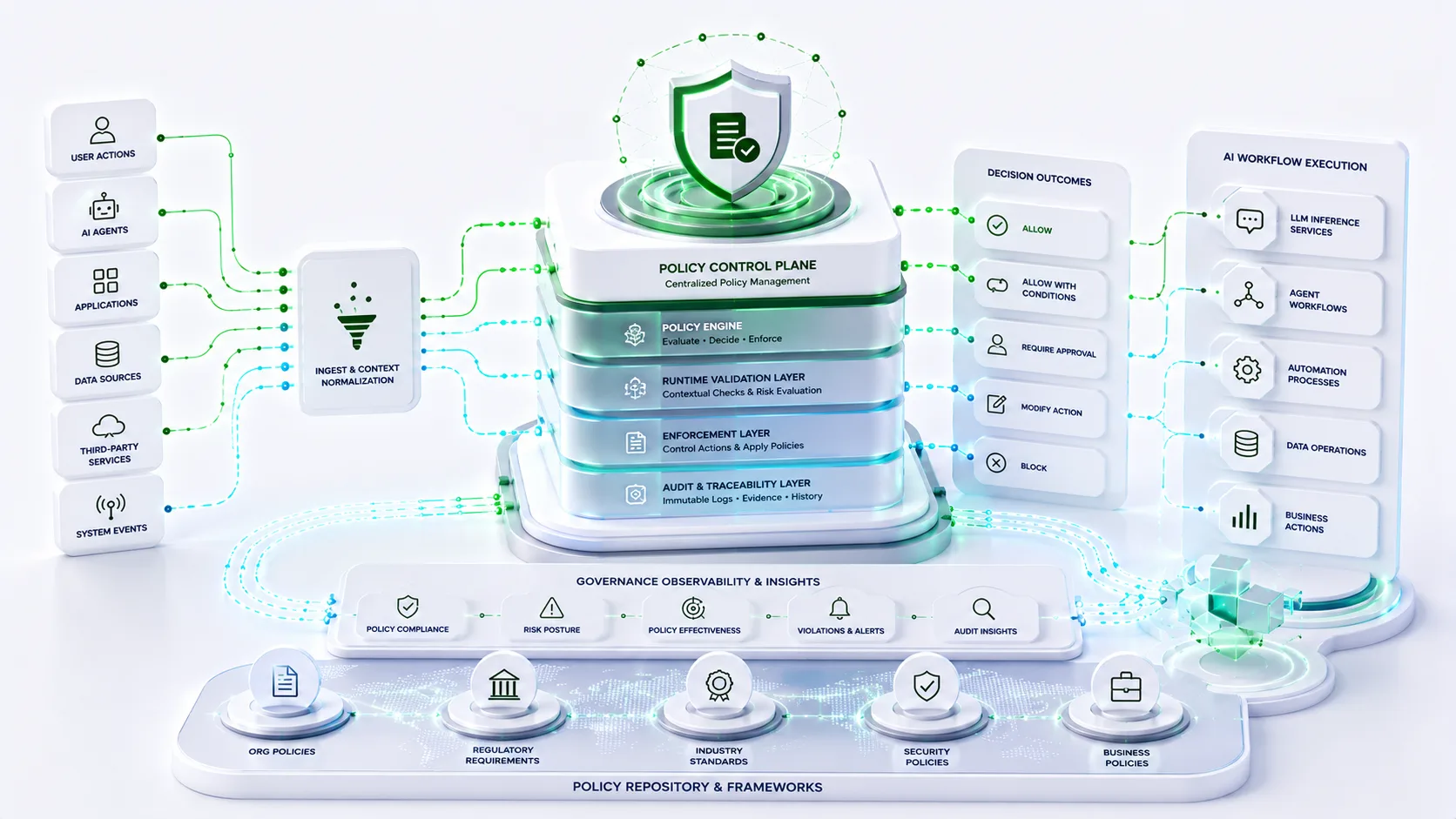
AI Policy-as-Code: The Future of Enterprise AI Governance
Enterprise AI is entering a new phase of maturity. Organizations are rapidly moving beyond experimentation and deploying autonomous AI systems that influence business decisions, coordinate workflows, execute actions, and interact directly with enterprise infrastructure.
While the benefits of AI autonomy are significant, they introduce a critical challenge: governance at scale.
Traditional governance approaches rely heavily on static documentation, manual reviews, audit processes, and human oversight. These methods struggle to keep pace with AI systems operating continuously across distributed cloud-native environments.
As a result, leading enterprises are embracing a new paradigm: AI Policy-as-Code.
Policy-as-Code enables organizations to transform governance requirements into executable policies that can be automatically enforced across AI workflows, models, agents, and infrastructure in real time.
In many ways, AI Policy-as-Code is becoming the operational foundation of modern AI governance.
What Is AI Policy-as-Code?
AI Policy-as-Code is the practice of defining governance, security, compliance, risk, and operational requirements as machine-readable policies that can be automatically enforced by AI systems and infrastructure platforms.
Rather than relying solely on written governance documents, organizations encode rules directly into operational environments.
Examples include:
- Data access restrictions
- Model usage policies
- Agent execution permissions
- Compliance requirements
- Risk thresholds
- Human approval workflows
- Audit and logging requirements
- Security controls
Policies become executable governance controls that operate continuously.
Why Traditional AI Governance Is No Longer Enough
Many organizations still govern AI using manual processes.
These approaches often include:
- Governance committees
- Security reviews
- Policy documentation
- Compliance audits
- Human approval processes
While important, these methods were designed for systems that change relatively slowly.
Modern AI environments are different.
Organizations now operate:
- Autonomous AI agents
- Multi-agent orchestration systems
- Real-time AI workflows
- Dynamic inference environments
- Cloud-native AI platforms
Governance must operate at machine speed.
This is the fundamental problem Policy-as-Code solves.
The Evolution of Governance Engineering
Policy-as-Code follows a broader industry trend toward engineering-driven governance.
Organizations have already adopted:
- Infrastructure-as-Code
- Security-as-Code
- Compliance-as-Code
- Observability-as-Code
AI Policy-as-Code extends these principles into enterprise AI operations.
Governance becomes embedded within the technology stack itself rather than existing as a separate process.
Core Components of AI Policy-as-Code
1. Policy Definition Layer
This layer defines organizational requirements using machine-readable formats.
Policies may govern:
- Data access
- Agent permissions
- Model selection
- Risk controls
- Operational boundaries
- Compliance requirements
Policies become standardized and reusable across environments.
2. Policy Enforcement Engines
Enforcement engines evaluate AI actions against defined policies.
Before execution occurs, systems verify compliance with governance requirements.
This enables real-time policy validation.
3. Runtime Governance Systems
Runtime governance continuously monitors AI behavior during operation.
Capabilities include:
- Decision validation
- Risk assessment
- Execution monitoring
- Behavior analysis
- Compliance verification
This creates active governance rather than passive oversight.
4. Audit and Traceability Layers
Every decision, action, and policy evaluation should be logged.
Organizations require:
- Audit trails
- Decision histories
- Policy evaluation records
- Execution traces
- Compliance evidence
This improves accountability and regulatory readiness.
How AI Policy-as-Code Works in Practice
Imagine an autonomous AI agent attempting to approve a high-value financial transaction.
Before execution:
- The request enters the governance layer.
- Policy engines evaluate organizational rules.
- Risk scoring systems assess impact.
- Compliance requirements are validated.
- Human approval requirements are checked.
- The action is approved, rejected, or escalated.
All of this occurs automatically within milliseconds.
The result is governance operating at the same speed as AI systems.
AI Policy-as-Code and Multi-Agent Systems
Multi-agent architectures introduce additional governance complexity.
Organizations must govern:
- Agent identities
- Agent permissions
- Agent collaboration pathways
- Workflow execution rights
- Data access boundaries
- Escalation policies
Policy-as-Code provides a centralized governance mechanism capable of managing thousands of autonomous interactions across distributed AI ecosystems.
Key Enterprise Use Cases
Financial Services
Automated enforcement of transaction limits, compliance requirements, fraud controls, and approval policies.
Healthcare
Governance policies controlling patient data access, model recommendations, and clinical workflow execution.
Cybersecurity
Autonomous response systems governed through policy-driven execution controls and risk management frameworks.
Software Engineering
AI-assisted deployment systems validating governance requirements before production changes occur.
Customer Operations
Customer-facing AI agents following approved escalation paths and communication policies.
Benefits of AI Policy-as-Code
Consistent Governance
Policies are enforced uniformly across environments and teams.
Scalable Compliance
Organizations can manage governance across large AI ecosystems without relying entirely on manual reviews.
Faster Decision-Making
Automated validation reduces governance bottlenecks.
Improved Auditability
Every policy evaluation can be tracked and reviewed.
Reduced Operational Risk
AI actions are continuously evaluated against organizational requirements.
The Role of AI Control Planes
AI control planes are emerging as the operational foundation for Policy-as-Code.
Control planes provide:
- Centralized policy management
- Governance orchestration
- Runtime enforcement
- Observability integration
- Agent oversight
- Compliance monitoring
They serve as the command center for enterprise AI governance.
Challenges Organizations Must Address
- Policy complexity
- Cross-platform governance
- Rapid AI adoption
- Evolving regulations
- Agent coordination challenges
- Policy lifecycle management
- Governance scalability
Successfully implementing Policy-as-Code requires close collaboration between engineering, security, compliance, and operations teams.
Building an AI Policy-as-Code Strategy
Organizations should focus on six foundational areas:
- Governance framework design
- Policy standardization
- Runtime governance platforms
- AI control planes
- Observability systems
- Continuous compliance automation
Together, these capabilities create a scalable governance architecture capable of supporting autonomous AI operations.
The Future of Enterprise AI Governance
As autonomous AI systems become more sophisticated, governance must become equally intelligent.
The future will likely involve:
- Dynamic policy adaptation
- Risk-aware governance engines
- Autonomous compliance validation
- AI-assisted policy management
- Continuous governance automation
Policy-as-Code will increasingly become a foundational requirement for enterprise AI maturity.
Key Takeaways
- AI Policy-as-Code transforms governance requirements into executable controls.
- Governance can operate at machine speed alongside autonomous AI systems.
- Runtime enforcement improves compliance, security, and reliability.
- Multi-agent environments make Policy-as-Code increasingly important.
- AI control planes are becoming central to governance automation.
How YggyTech Helps
YggyTech helps organizations build governance-first AI architectures through AI control planes, Policy-as-Code frameworks, runtime governance systems, operational intelligence platforms, and compliance automation solutions.
Our approach enables enterprises to deploy autonomous AI confidently while maintaining governance, security, reliability, and operational transparency.
Conclusion
The future of enterprise AI governance will not be managed through documents alone.
It will be encoded, automated, continuously enforced, and integrated directly into operational infrastructure.
AI Policy-as-Code represents the next major evolution of governance engineering, enabling organizations to scale autonomous AI systems without sacrificing trust, control, or compliance.
For enterprises building the next generation of AI platforms, Policy-as-Code is rapidly becoming a strategic necessity.
FAQs
What is AI Policy-as-Code?
AI Policy-as-Code is the practice of defining governance and compliance requirements as executable policies that can be automatically enforced by AI systems and infrastructure.
Why is Policy-as-Code important for AI governance?
It enables governance to operate at machine speed, ensuring continuous compliance and risk management across autonomous AI systems.
How does Policy-as-Code support multi-agent systems?
It governs agent permissions, collaboration pathways, execution rights, and operational boundaries through centralized policy enforcement.
What role do AI control planes play?
AI control planes provide centralized governance, policy enforcement, observability, and operational oversight across enterprise AI environments.
What are the benefits of AI Policy-as-Code?
Key benefits include automated compliance, improved auditability, reduced risk, scalable governance, and consistent policy enforcement.

Sarah Anderson
Head of Content
Sarah leads the content strategy at Yggy Tech, bringing 10+ years of experience in technology writing and editorial direction.


