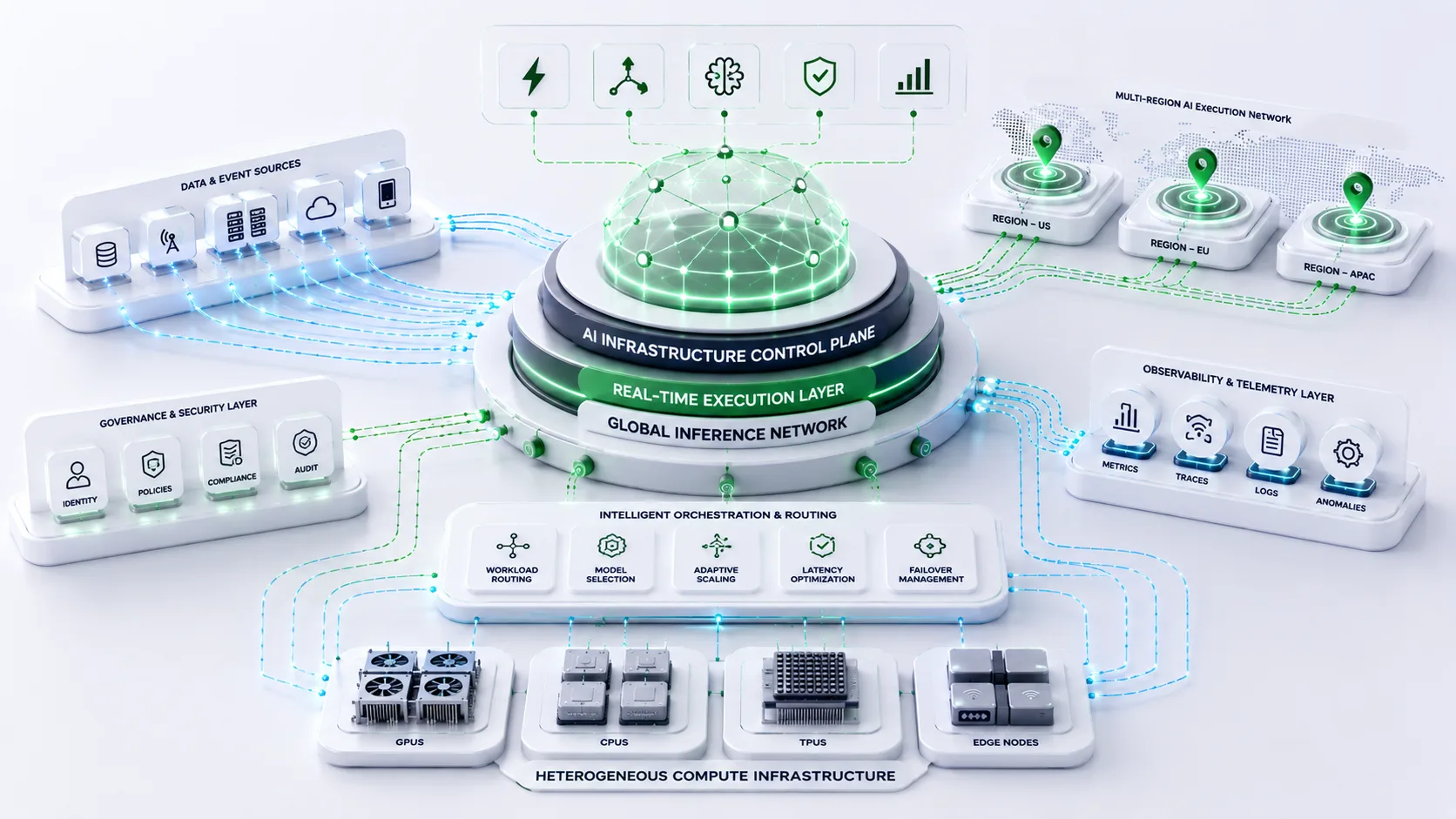
Real-Time AI Infrastructure for Mission-Critical Operations
Artificial Intelligence is rapidly moving from experimental environments into mission-critical enterprise operations where milliseconds matter, reliability is non-negotiable, and operational failures can have significant business consequences.
Whether powering autonomous customer service systems, financial fraud detection platforms, industrial automation workflows, healthcare decision support systems, or enterprise operational intelligence platforms, AI is increasingly becoming part of the core operational fabric of modern organizations.
As adoption accelerates, enterprises face a fundamental challenge: traditional infrastructure architectures were never designed for real-time AI execution at scale.
Modern mission-critical AI systems require a new generation of infrastructure capable of delivering low-latency inference, resilient orchestration, continuous observability, governance enforcement, and autonomous operational coordination across highly distributed environments.
The New Reality of Enterprise AI Operations
Many organizations initially approached AI as an analytics or productivity tool. Today, AI is increasingly becoming an operational decision engine.
Examples include:
- Autonomous customer engagement platforms
- Financial risk and fraud detection systems
- Supply chain optimization engines
- Industrial process automation systems
- Healthcare operational intelligence platforms
- Cybersecurity response automation
- Real-time logistics coordination systems
In these environments, delays, downtime, inaccurate outputs, or infrastructure failures can directly impact revenue, operations, compliance, and customer experience.
Why Real-Time Infrastructure Matters
Mission-critical AI workloads require infrastructure capable of processing data, executing models, and delivering decisions within strict latency boundaries.
Unlike traditional batch-processing architectures, modern AI systems must operate continuously while maintaining high availability and operational consistency.
Core Requirements Include:
- Sub-second inference execution
- High-throughput processing pipelines
- Multi-region resiliency
- Continuous observability
- Runtime governance enforcement
- Automated recovery systems
- Scalable orchestration platforms
The Architecture of Real-Time AI Infrastructure
1. Distributed Inference Layers
Inference infrastructure sits at the center of modern AI operations.
Instead of relying on centralized execution environments, enterprises increasingly distribute inference workloads across cloud regions, edge environments, and specialized compute clusters.
This architecture reduces latency while improving operational resilience.
Key Components:
- Model serving platforms
- GPU orchestration systems
- Load-balancing layers
- Inference gateways
- Execution routing systems
- Regional deployment clusters
2. AI Control Planes
As organizations deploy multiple AI models and autonomous workflows, centralized control planes become essential.
Control planes coordinate:
- Inference routing
- Agent orchestration
- Policy enforcement
- Model lifecycle management
- Runtime governance
- Operational monitoring
These systems function as the operational command center of enterprise AI infrastructure.
3. Telemetry and Observability Systems
Mission-critical operations require complete visibility into AI behavior.
Modern AI observability platforms provide insight into:
- Inference latency
- Model performance
- Infrastructure utilization
- Operational anomalies
- Workflow execution paths
- Agent decision chains
- Governance compliance status
Without observability, organizations operate AI systems blindly.
The Rise of Operational AI Intelligence
One of the biggest shifts occurring in enterprise AI is the movement from passive monitoring toward operational intelligence.
Modern platforms no longer simply observe infrastructure.
They actively analyze telemetry streams, identify emerging risks, recommend remediation actions, and increasingly automate operational responses.
This transition is transforming AI infrastructure from reactive systems into adaptive operational platforms.
Infrastructure Resilience as a Strategic Requirement
Mission-critical AI systems must continue functioning even during infrastructure failures.
Resilience is no longer a nice-to-have capability.
It is becoming a fundamental architectural requirement.
Key Resilience Capabilities:
- Multi-region failover
- Distributed execution environments
- Intelligent workload rerouting
- Infrastructure redundancy
- Autonomous recovery workflows
- Self-healing orchestration systems
The most advanced enterprises design for failure from the beginning rather than treating resilience as an afterthought.
Runtime Governance for Operational AI
As AI systems gain operational authority, governance becomes increasingly important.
Mission-critical infrastructure must ensure every decision, workflow, and execution path remains within approved operational boundaries.
Runtime Governance Functions:
- Policy enforcement
- Identity verification
- Access management
- Compliance monitoring
- Decision traceability
- Operational auditability
Governance frameworks help enterprises scale AI adoption without sacrificing security, trust, or compliance.
Multi-Agent Systems and Infrastructure Complexity
Enterprise AI is evolving beyond single-model deployments.
Organizations are increasingly implementing multi-agent systems that coordinate specialized AI agents across operational workflows.
These environments introduce new infrastructure challenges:
- Agent coordination
- Context synchronization
- Workflow orchestration
- Execution visibility
- Policy management
- Operational governance
Real-time infrastructure serves as the foundation enabling these distributed AI ecosystems to operate reliably.
Enterprise Use Cases
Financial Services
Fraud detection systems must evaluate transactions within milliseconds while maintaining regulatory compliance and operational reliability.
Healthcare
Clinical decision-support systems require real-time processing capabilities combined with strict governance controls and operational transparency.
Manufacturing
Industrial automation environments depend on continuous AI execution for predictive maintenance, process optimization, and operational monitoring.
Logistics
AI-powered routing systems coordinate dynamic transportation networks while continuously adapting to changing operational conditions.
Cybersecurity
Threat detection platforms increasingly leverage AI to identify, prioritize, and respond to incidents in real time.
Common Enterprise Mistakes
- Treating AI as an isolated application rather than operational infrastructure
- Underestimating observability requirements
- Ignoring governance architecture
- Over-centralizing inference workloads
- Lacking resilience planning
- Deploying AI without runtime visibility
- Separating infrastructure and AI operations teams
Building a Mission-Critical AI Infrastructure Strategy
Organizations should focus on five foundational pillars:
Scalable Inference Infrastructure
Support growing AI workloads without compromising latency or reliability.
Operational Observability
Create end-to-end visibility across models, agents, infrastructure, and workflows.
Runtime Governance
Enforce policies continuously rather than relying on static controls.
Resilience Engineering
Design systems capable of operating through failures.
Intelligent Orchestration
Coordinate distributed AI systems through centralized operational control planes.
Mission-Critical AI Infrastructure Checklist
- Distributed inference architecture
- Multi-region deployment strategy
- Operational telemetry pipelines
- AI observability platform
- Runtime governance framework
- Zero Trust security architecture
- Resilient orchestration systems
- Automated recovery workflows
- Operational intelligence layer
- AI control plane implementation
Key Takeaways
- Real-time AI infrastructure is becoming essential for mission-critical operations.
- Inference, observability, governance, and resilience must operate as a unified system.
- Distributed architectures reduce latency while improving reliability.
- Operational intelligence is becoming a core infrastructure capability.
- AI control planes are emerging as the operational backbone of enterprise AI ecosystems.
How YggyTech Helps
YggyTech helps enterprises design, deploy, and optimize mission-critical AI infrastructure through modern cloud-native architectures, observability systems, runtime governance frameworks, AI control planes, and resilient operational platforms.
Our expertise spans AI orchestration, inference infrastructure, platform engineering, operational intelligence, and enterprise-scale AI operations.
Conclusion
As enterprises move AI into mission-critical workflows, infrastructure becomes a strategic differentiator.
The organizations that succeed in 2026 and beyond will be those that invest not only in models, but in the operational systems that allow AI to function reliably, securely, and intelligently at scale.
Real-time AI infrastructure is no longer supporting enterprise operations—it is becoming the operational foundation itself.
FAQs
What is real-time AI infrastructure?
Real-time AI infrastructure refers to the systems, platforms, and operational architecture that enable low-latency AI execution, monitoring, governance, and orchestration across enterprise environments.
Why is real-time infrastructure important for AI?
Mission-critical AI workloads require rapid decision-making, operational reliability, and continuous visibility that traditional architectures often cannot provide.
What role does observability play in AI infrastructure?
Observability provides visibility into model performance, infrastructure health, workflow execution, and operational risks.
How do AI control planes support enterprise operations?
AI control planes coordinate distributed AI systems, enforce policies, manage workflows, and provide centralized operational oversight.
What industries benefit most from mission-critical AI infrastructure?
Financial services, healthcare, manufacturing, logistics, cybersecurity, and large-scale enterprise operations are among the sectors seeing the greatest impact.

Sarah Anderson
Head of Content
Sarah leads the content strategy at Yggy Tech, bringing 10+ years of experience in technology writing and editorial direction.


